
What is the main causes of hyperopia (Farsightedness)?
Hyperopia, also known as farsightedness, is a refractive error of the eye in which distant objects can be seen clearly, but near objects appear blurred. The main cause of hyperopia is a short eyeball, which causes the light entering the eye to focus behind the retina instead of directly on it. This can also occur when the cornea (the clear outer layer of the eye) is too flat.
In some cases, hyperopia can also be caused by a lens that is not flexible enough to focus properly, or by a problem with the shape of the cornea or lens. It can be hereditary and may also be associated with certain medical conditions such as diabetes or multiple sclerosis.

Hyperopia can be corrected using glasses, contact lenses, or refractive surgery. It is important to have regular eye exams to detect and correct any vision problems, including hyperopia.
How is hyperopia treated?
Hyperopia, or farsightedness, can be corrected using several different methods, including eyeglasses, contact lenses, and refractive surgery. The choice of treatment depends on the severity of the hyperopia, the age of the patient, and other factors.

- Eyeglasses: Prescription eyeglasses can help correct hyperopia by altering the way light enters the eye. The lenses are designed to refract the light in a way that compensates for the shape of the eye and focuses it properly on the retina. Eyeglasses are the most common and simplest form of treatment for hyperopia.
- Contact lenses: Like eyeglasses, contact lenses can be used to correct hyperopia by refracting light entering the eye. They sit directly on the cornea, and they are available in different materials and designs to suit different patient needs.
- Refractive surgery: In some cases, refractive surgery can be used to correct hyperopia. The most common types of refractive surgery for hyperopia are LASIK and PRK. These surgeries use a laser to reshape the cornea, changing the way light enters the eye and allowing it to focus properly on the retina.
It is important to have regular eye exams to detect and correct any vision problems, including hyperopia. Your eye doctor can help you decide which treatment is best for you.
What is the difference between hyperopia and myopia?
Hyperopia and myopia are two common refractive errors of the eye, but they have opposite effects on vision.
Hyperopia, also known as farsightedness, is a condition in which distant objects are clear, but close-up objects appear blurry. This occurs when the eyeball is too short, or the cornea is too flat, causing light to focus behind the retina instead of directly on it. People with hyperopia can have difficulty seeing up close, but may be able to see distant objects clearly.

Myopia, also known as nearsightedness, is a condition in which close-up objects are clear, but distant objects appear blurry. This occurs when the eyeball is too long, or the cornea is too curved, causing light to focus in front of the retina instead of directly on it. People with myopia can have difficulty seeing distant objects, but may be able to see up close without any problem.
Both hyperopia and myopia can be corrected using eyeglasses, contact lenses, or refractive surgery. The choice of treatment depends on the severity of the refractive error, the age of the patient, and other factors. It is important to have regular eye exams to detect and correct any vision problems, including hyperopia or myopia.
How is laser correction of hyperopia (Farsightedness)?
Laser correction of hyperopia (Farsightedness), also known as hyperopic LASIK, is a type of refractive surgery that uses a laser to reshape the cornea and correct farsightedness. This procedure is similar to LASIK (laser-assisted in situ keratomileusis), which is used to correct myopia (nearsightedness).
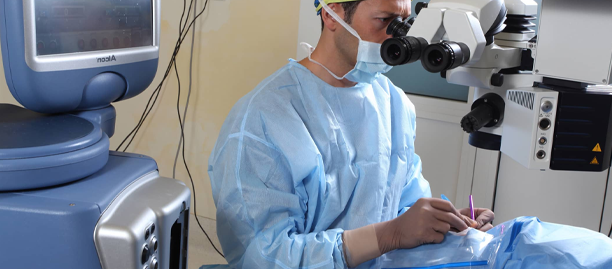
During hyperopic LASIK, a surgeon creates a thin flap on the surface of the cornea using a microkeratome or a femtosecond laser. The flap is lifted, and a laser is used to remove a small amount of tissue from the center of the cornea. The laser is then used to reshape the cornea to a more optimal curvature, allowing light to focus correctly on the retina. The flap is then replaced, and the eye is allowed to heal.
Hyperopic LASIK can be an effective treatment for hyperopia, but it is not suitable for everyone. The procedure is generally more effective for people with low to moderate hyperopia, and it may not be recommended for those with severe hyperopia or other eye conditions. The risks and benefits of the procedure should be carefully evaluated by an experienced eye surgeon before any treatment is undertaken.
As with any surgery, there are risks associated with hyperopic LASIK, including infection, undercorrection or overcorrection of the refractive error, dry eye, and night vision problems. It is important to have a thorough eye exam and discuss the risks and benefits of the procedure with an experienced eye surgeon before making a decision about treatment.
Can hyperopia be cured permanently?
Hyperopia, or farsightedness, can be corrected permanently with refractive surgery. Refractive surgery is a type of surgical procedure that changes the shape of the cornea or the lens in the eye to correct refractive errors such as hyperopia.

The most common type of refractive surgery for hyperopia is LASIK, which uses a laser to reshape the cornea and correct the refractive error. Other types of refractive surgery for hyperopia include PRK (photorefractive keratectomy), LASEK (laser epithelial keratomileusis), and RLE (refractive lens exchange).
While these procedures can be very effective in correcting hyperopia, they are not without risks, and not everyone is a good candidate for surgery.